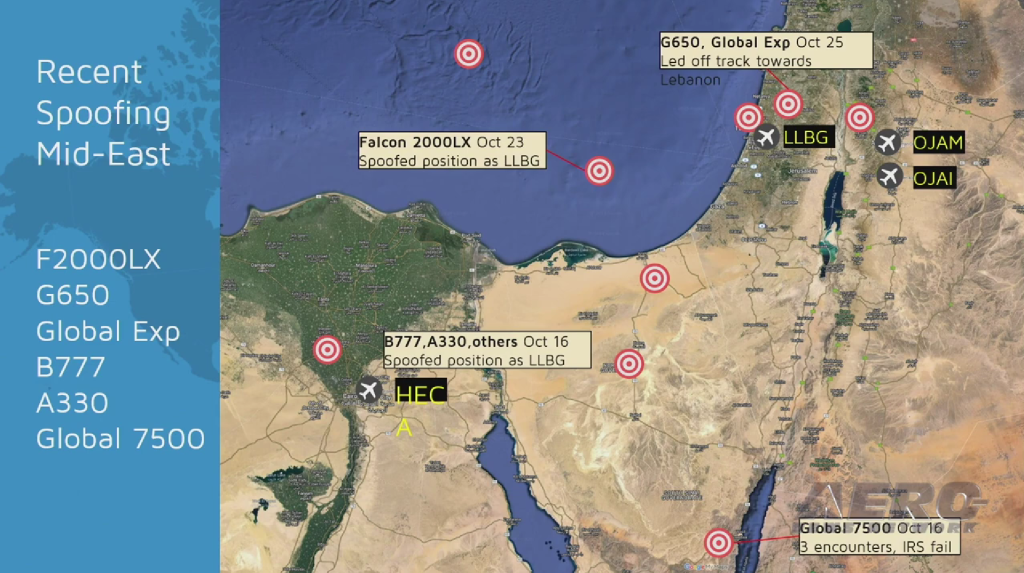
During his presentation at AEA 2024, Jonathan Pinson of Airtext shifted the conversation from entertainment to a critical safety concern: the reliability of primary navigation sources. Pinson detailed the increasing prevalence of GPS spoofing, where an aircraft is tricked into accepting a false position, leading to potential systems failure.
What is GPS spoofing?
Unlike simple jamming, spoofing involves an aircraft receiving a false GPS position. Pinson explained that these false positions can be so significant that they cause failures in other systems highly reliant on GPS, such as Ground Proximity Warning Systems (GPWS) and Traffic Collision Avoidance Systems (TCAS).
The presentation cited reports of interference lasting over 300 nautical miles, creating sustained navigational hazards.
A Global Issue
While recent conflicts have highlighted issues in the Middle East involving modern aircraft (such as the Falcon 2000LX and Global Express), Pinson emphasized that this is a worldwide problem, not limited to conflict zones.
Recent International Incidents:
- Baltic Sea: An instance occurred recently around Sweden, Germany, and Finland, affecting over 850 civilian aircraft.
Domestic U.S. Incidents:
- Dallas (DFW), Oct 2022: A 44-hour period of spoofing took out Runway 35 Right.
- Denver (DEN), Jan 2022: A 33-hour period of jamming occurred.
- Sun Valley, ID, 2019: An aircraft was nearly spoofed into a mountain, saved only by an air traffic controller monitoring radar hundreds of miles away.
